
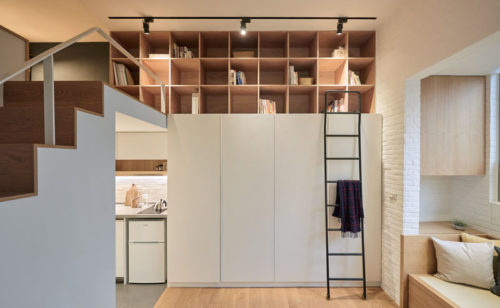
I love the quiet elegance of this small loft in Taipei, Taiwan. Young creatives from A Little Design studio managed to build an airy and serene dwelling, with only 236 square feet to work with. The flow of this apartment contributes to the illusion of spaciousness. The narrow passage between the kitchen and the bedroom opens up to the living room, immediately creating a feeling to a much bigger room. The built-in couch is quite big to accommodate enough people, yet it is out of the way, tucked in next to the window. The bar tables, placed against the wall, also take very little space. They double as a desk, and, if guests are over, they can be put together in the middle of the room to create one full-size dinner table. The swing-arm lamp rotates between the desk and a couch. The loft contains a bed and another small desk. High shelves complete this interior, providing storage and an illusion of height.

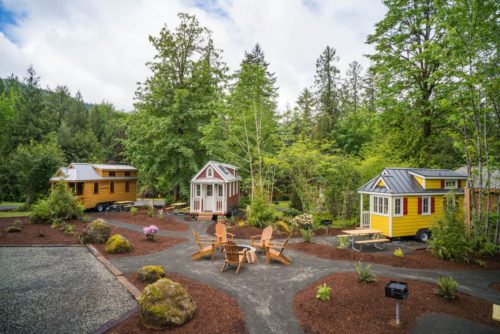
If you are intrigued by the tiny house idea of living, but not quite sure if it suits you, you can now test drive it during your vacation. A beautiful cluster of tiny houses, called Tiny House Village, has been built in the Oregon forest, for people to enjoy for short periods of time. The houses range from 178 to 261 square feet, and sleep two to five guests. They cost between $129 and $139 per night to rent, depending on their size. There is a communal area in the middle of the camping site, so you can socialize with other tiny house enthusiasts. This seems like a fun and safe way to experience the confined realities of mortgage-free life before making it permanent. Or just an unusual outdoorsy vacay alternative. Check out more photos after the break.

This video shows a delightful report on living and entertaining in one of New York’s smallest spaces. It made my weekend.

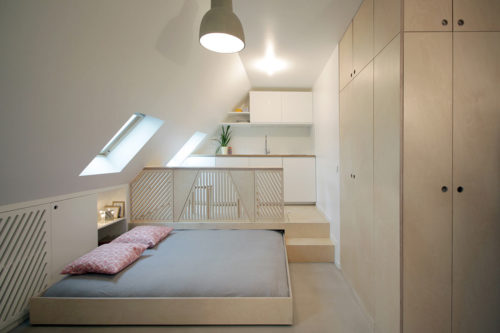
This lovely renovation of the 161-square-foot apartment is a proof that there is hope for any space, however tiny, to be livable and chic. Studio Batiik transformed a dingy old attic into a light and beautiful pad, inventive in its flexibility. The kitchen is raised above the main level, providing an ample space to hide the bed and free the room for dining and entertaining. When the bed is away, the kitchen counter unfolds to fit four guests comfortably. It is even possible to hide the bed half the way, add pillows, and turn it into a lounging spot. Every bit of non-slanted wall is used for storage. The tiny space next to the bathroom houses a small desk, with the natural light coming from the window. See the photos after the break for a full tour.

https://vimeo.com/156852806
As surprising as it sounds, a Dutch design company Fiction Factory creates modular, compact, and lightweight prefabs from nothing other than large rolls of recycled corrugated cardboard. Called Wikkelhouses, these stylish and eco-friendly dwellings, are comprised of modular elements that you can add, mix, and adopt to your unique needs and desired setting. How timely is this? Each Wikkelhouse is build in a workshop in Amsterdam, and when all the elements are ready, it can be assembled on location in only one day. Each Wikkelhouse is finished with waterproof coating and wood panelling to protect it from all weather conditions. A fantastic idea, beautifully designed.

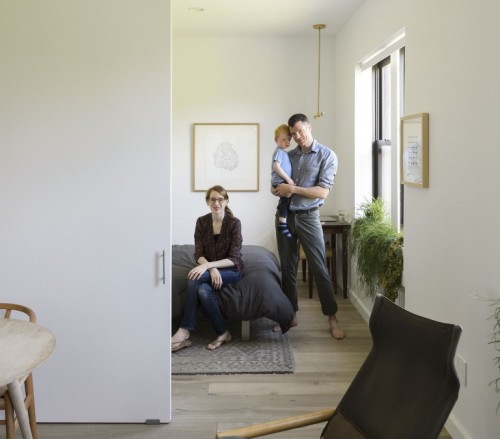
The thoughtful asceticism of this space simply made my day. Imagine, a young couple with two small children, residing in a 675 square-foot apartment, is able maintain a minimalist lifestyle. Gives hope to many of us, doesn’t it. A dark and outdated pre-war one bedroom apartment with an awkward nook, used as a second bedroom, was transformed by the architect David Bucovy into a serene and spacious pad. All beds here, children and adult, are murphy beds. All items have a clear purpose. Most spaces are multifunctional. Toys (including laptops) are stored away when not in use. I love how the neutral and calm tone of the apartment serves as a backdrop to the carefully curated mid-century furniture pieces (a separate swoon for the Wegner dining chairs). Check out the photos after the break for the full tour.
Photography by Matthew Williams.

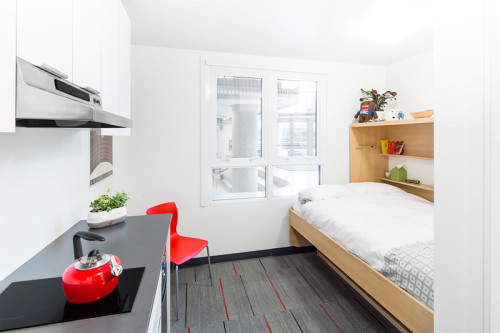
This tiny 140 square-foot studio is a prototype of student housing, offered by the University of British Columbia in Vancouver, Canada. Thanks to the inventive use of space, the Nano Stuite includes all the essentials, such as a kitchen, bathroom, and sleep/study space. The main space-saver here is the bed, transforming into a desk. Very clever. Check out the video after the break to see a virtual tour of this apartment.

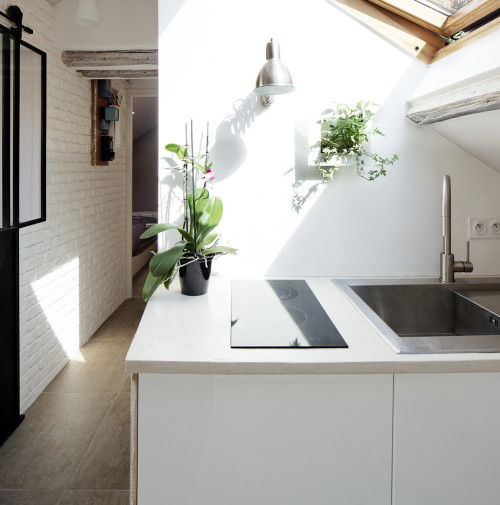
This clever and chic little apartment is a reincarnation of the awkward attic, redesigned by Prisca Pellerin. To maximize the space and make a good use of the natural light, the architect removed doors and created a unified flow between the living room, kitchen and bathroom. The only truly private spots here are the toilet and the small bedroom, which is minimalist and serene. The color scheme of the entire project explores combinations of white and grey, guiding the eye through different textures of the same two colors (another trick to visually expand the space). Check out the floor plan and more photos after the break.

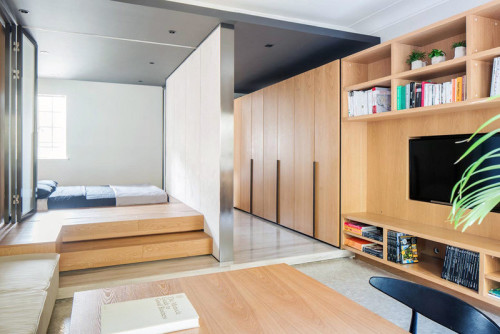
This tiny studio apartment in Shanghai has been transformed by designers at MoreDesignOffice. What was previously one boxy space, became a beautiful pad with great flow and light. My favorite feature of the place is an elevated sleeping area. It creates an effect of another room, the steps leading to the bed work as seating during parties, and the room below the bed serves as much needed storage. Instead of a coffee table, designers opted for a proper dining table and utilized the large couch as dining seating. The small corridor leading to the kitchen features flow-to-ceiling built-in storage. The opposite wall of the corridor is clad with a full height mirror, which reflect the light and makes the space look even more spacious.

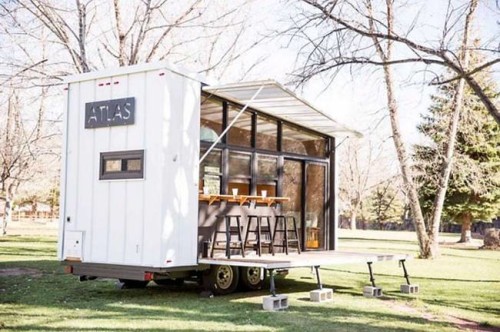
As the Tiny House movement evolves, so do the ways to deal with common cramped living problems. This particular one addresses the inability to invite people over without feeling claustrophobic. Atlas, the compact 196-square-foot dwelling, has been designed by Blake Dinkins, Lance Cayko, Alex Gore, and Sarah Schulz, who all met at North Dakota State University in Fargo. They came up with a great idea to turn one of the walls into a fold-down patio deck. This elegant solution increases seating space around a cool and convenient bar, it also brings in light from the great outdoors. See more photos and a floor plan after the break.
