

Flexible Joinery is a clever creation from israeli design lab Dag. The idea is to provide a temporary and adaptable joining function, which can serve many purposes around your house. Made out of a silicone casting over an inner metal skeleton, these joining elements are flexible and strong at the same time. The technology dates back to the 1950’s, with Bruno Munari’s ‘Zizi the monkey’. According to Desingboom, the pink color of the elements is meant to give visual contrast against wooden shelves.


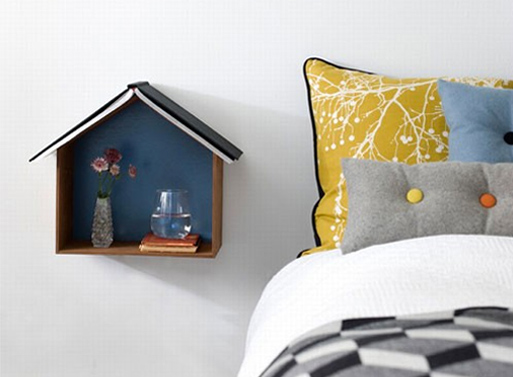
This unusual shelf from Fern Living, called Studio 1, beautifully doubles as a wall decoration. If displayed on a wall in several different sizes and colors, it creates a cute skyline (with the possibility of storage and/or display). You can also use it as a bedside reading nest. It can house your alarm clock, a glass of water and some other small items. The ‘roof’ can serve as a bookmark. With its size and openness, Studio 1 also promotes minimal, clutter free approach to storage.
Source: Better Living Through Design


No matter what kind of opinions you hold on the subject, your cat will always believe that climbing on top of bookcases is awesome. And majestically eyeing the premises from the top shelf is even awesomer. You can enter a painful (and most likely futile) process of imposing restrictions on the cat, or you can embrase the inevitable and give him/her this brilliant thing. Created by belgian designer Corentin Dombrecht, the Cat Library bookcase is made in a shape of a staircase with a built-in sitting basket at its top. The piece is modular, which allows to fit it in any space. According to Designboom, the shelf is intentionally unpainted and is not oiled, so that the surface is not too slippery for cat paws. So, this may be furniture to you, to your cat it is just another toy. But isn’t this true for everything else in your home?


This piece is a combination of raw function and illusion, created by the Lisbon-based designer Fernando Brízio for Droog. From a certain angle it looks like a real side table with an open drawer, but, as the product name suggests, What You See Is Not. In reality only the drawer is three-dimensional, the rest of the piece is a sticker on a wall. Here is how Brizio describes this concept: ‘The illusion in this piece creates a situation where you observe the object’s form and deform, depending on your position in space. I am interested in this type of interaction between the object and the viewer—what you see is a result of who you are, how you think and how you are mentally and physically constituted.’ The What You See Is Not side table also allows to save on materials. So, it only tricks the eye, not the environment…


The Stockholm Furniture Fair 2011 is in full swing, and the first news are coming in. Yesterday the world beheld the winner of the Forms+1 Award for the best product at this year’s exhibition. The award went to Thomas Bernstrand for his stackable storage system, called Ivy. This unusual piece, produced by the Swedish company Swedese, consists of five stackable components that can be arranged in three ways: straight-up, leaning to one side, or alternating. The last two choices allow to play with the object, creating fun and dynamic shelving. But even in a traditional, straight-up version it looks rather interesting. And because the Ivy system is stackable, you can customize it, divite it in two, or take it apart completely with ease.


If you like multifunctional, adjustable and slightly nerdy designs – you will love this lamp. The LichtKiste from German creator Clemens Tiss is a light box with two panels removed. The remaining panels are rearranged to adjust the light intensity. The LichtKiste lamp can take numberless shapes and formes. It also dobles as a side table with the possibility of shelving (when the panels are slided closer to each other). What is not to love?..


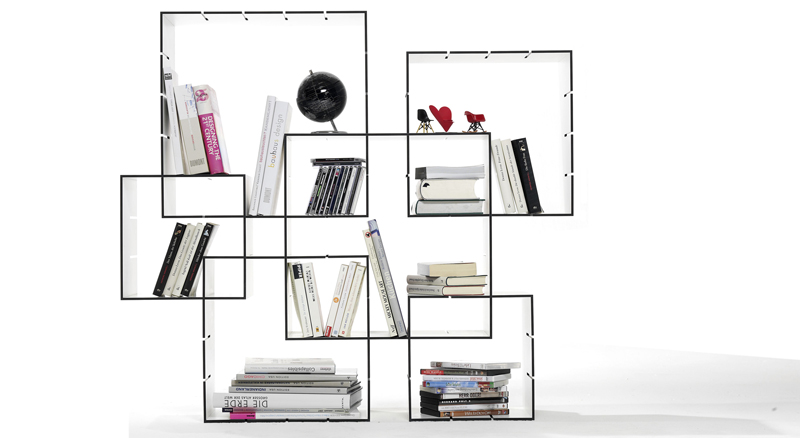
This project has won the Interior Innovation Award during Imm Cologne 2011, which is not the least bit surprising. German designer Florian Gross has created a universally likable piece, called Konnex, that has all attributes we want to see in a bookcase. It is light, modular, stackable, easy to put together, fully customizable in any room, big or small. And because the bookcase can be taken apart and stored in a form of nested modules, it is easy to ship as well. The combinations and uses of the Konnex bookcase are endless, it can even be paired with other furniture pieces, put under your desk, for example. Sold in sets of 3, the slot-in units can be stacked, added to, arranged and rearranged to the extent of your budget and imagination.


There is no reason whatsoever for bringing a boring bookcase into your home. Especially when pieces like this one exist. Designed by Kittichai Reawsanguanwong, the Chinese Checkered Bookshelf was made to draw attention to itself. According to Yanko Design, the bookshelf joints are fitted with magnets to hold the chess pieces. Although not actually playable, the pieces can be rearranged to add visual interest and variety. They can also hold notes and small items. The bookcase was displayed during the ‘Imprints: Designing for Memories’ exhibition at the National Museum of Singapore.


Twist is a stackable bookcase created by Giuseppe Bavuso for Alivar. The idea was to create a versatile and visually stimulating storage unit, suitable for any room. The final product fills the bill brilliantly, and then some. Twist can be used as a bookcase, a display unit, a night stand, even a pouf, if used with a cushion. Stackable components are made out of the Hi MACS acrylic stone. The units are divided by the glass shelves, which makes them even more light and airy. The illusion of irregular cubic shapes is a nice touch, it creates beautiful dynamic.


The words ‘modular’ and ‘customizable’ are music to our ears, especially if we live in an awkward and/or limited space. Consider the Cocoon, a versatile shelving unit created for Ideal Form Team by the Italian designer Paola Navone. The Cocoon allows all customization imaginable – the shelf can be built to fit any space and any stylistic preference. You can choose between open and closed storage, various effects and finishes, several digitally printed designs… The combinations are endless. As is fun to pick and change them.


