This piece is a combination of raw function and illusion, created by the Lisbon-based designer Fernando Brízio for Droog. From a certain angle it looks like a real side table with an open drawer, but, as the product name suggests, What You See Is Not. In reality only the drawer is three-dimensional, the rest of the piece is a sticker on a wall. Here is how Brizio describes this concept: ‘The illusion in this piece creates a situation where you observe the object’s form and deform, depending on your position in space. I am interested in this type of interaction between the object and the viewer—what you see is a result of who you are, how you think and how you are mentally and physically constituted.’ The What You See Is Not side table also allows to save on materials. So, it only tricks the eye, not the environment…


Here is an idea – furniture inspired by puzzles. And not just any puzzles – burr puzzles, assembled without a single nail or fastener. The result – a collection of beautiful pieces, made of natural, ecological materials, with no high-tech and no harmful glues. The project belongs to the Bulgarian studio Praktrik and created by the designer Petar Zaharinov, who sees big utilitarian and environmental potential in this puzzle idea. All items are sold in pieces that can be assembled and disassembled if not exactly with ease, but definitely with a lot of fun.


This neat little thing screams good sense. Envisioned by Swedish designer Jonas Forsman for Creatables, the Old News newspaper collector allows you to store your periodicals in style while they are waiting to be recycled. The piece itself is made from recycled sport felt, which is right up the same eco street. So, instead of chaotic piling you can now engage in some environmentally conscious accumulating. This does sound better.
Source: The Designer Pad


The Stockholm Furniture Fair 2011 is in full swing, and the first news are coming in. Yesterday the world beheld the winner of the Forms+1 Award for the best product at this year’s exhibition. The award went to Thomas Bernstrand for his stackable storage system, called Ivy. This unusual piece, produced by the Swedish company Swedese, consists of five stackable components that can be arranged in three ways: straight-up, leaning to one side, or alternating. The last two choices allow to play with the object, creating fun and dynamic shelving. But even in a traditional, straight-up version it looks rather interesting. And because the Ivy system is stackable, you can customize it, divite it in two, or take it apart completely with ease.


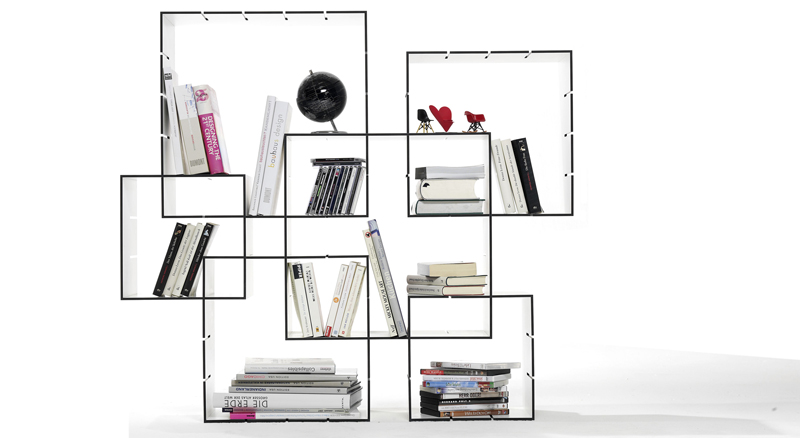
This project has won the Interior Innovation Award during Imm Cologne 2011, which is not the least bit surprising. German designer Florian Gross has created a universally likable piece, called Konnex, that has all attributes we want to see in a bookcase. It is light, modular, stackable, easy to put together, fully customizable in any room, big or small. And because the bookcase can be taken apart and stored in a form of nested modules, it is easy to ship as well. The combinations and uses of the Konnex bookcase are endless, it can even be paired with other furniture pieces, put under your desk, for example. Sold in sets of 3, the slot-in units can be stacked, added to, arranged and rearranged to the extent of your budget and imagination.


There is no reason whatsoever for bringing a boring bookcase into your home. Especially when pieces like this one exist. Designed by Kittichai Reawsanguanwong, the Chinese Checkered Bookshelf was made to draw attention to itself. According to Yanko Design, the bookshelf joints are fitted with magnets to hold the chess pieces. Although not actually playable, the pieces can be rearranged to add visual interest and variety. They can also hold notes and small items. The bookcase was displayed during the ‘Imprints: Designing for Memories’ exhibition at the National Museum of Singapore.


A spacious and functional workspace in the morning, a social hot-spot in the afternoon, and a dining table at night – these are the roles this piece of furniture can play. A truly multifunctional table, called Doppelleben, is the recent creation of the Ahhaproject design studio. The idea is ingenious in its simplicity. The tabletop consists of two layers. If you need to use the lower layer, you can slide two lightweight panels down the sides. And when the work is done (or is safe to be interrupted), the panels come up creating a surface for dining and entertaining. This working/dining combo is merely a suggestion, of course. You can use the lower layer tabletop as a bookshelf, a utensil storage, a display for your collectables, or in any way you see fit.


Combining sitting and book storage is a popular game these days, and here is another impressive effort in this direction. The Ransa sofa, designed by Younes Duret studio, consists of a sit elevated above the book shelves. The piece not only has the obvious space-saving capabilities, but also provides a pleasing book display. Ransa is big enough for an average person to lie down, which makes it a proper couch, designed for an avid bookworm. The piece only exists as a concept, but when put into production, it will surely find many fans.


Acoustable is a coffee table/sound system, created by two Belgian designers Jérôme Spriet and Wolfgang Bregentzer. The table consists of a base and a top with an advanced acoustic system resting in between. Here is how the designers describe the concept: ‘The project Acoustable is born out of a reflection on music and ways of listening to it. As the digital revolution has made music more widely available, mobile and compact, so a good quality dock is essential. The idea of an object which combines good acoustics with user-friendly ergonomics arises from these considerations. The coffee table at the center of the room becomes the sound system and the power terminal. There are no visible technical elements, only the player and a remote which can both be stored in a built in pocket.’ So there you have it – the table with one more good reason to gather around.
Source: Freshome


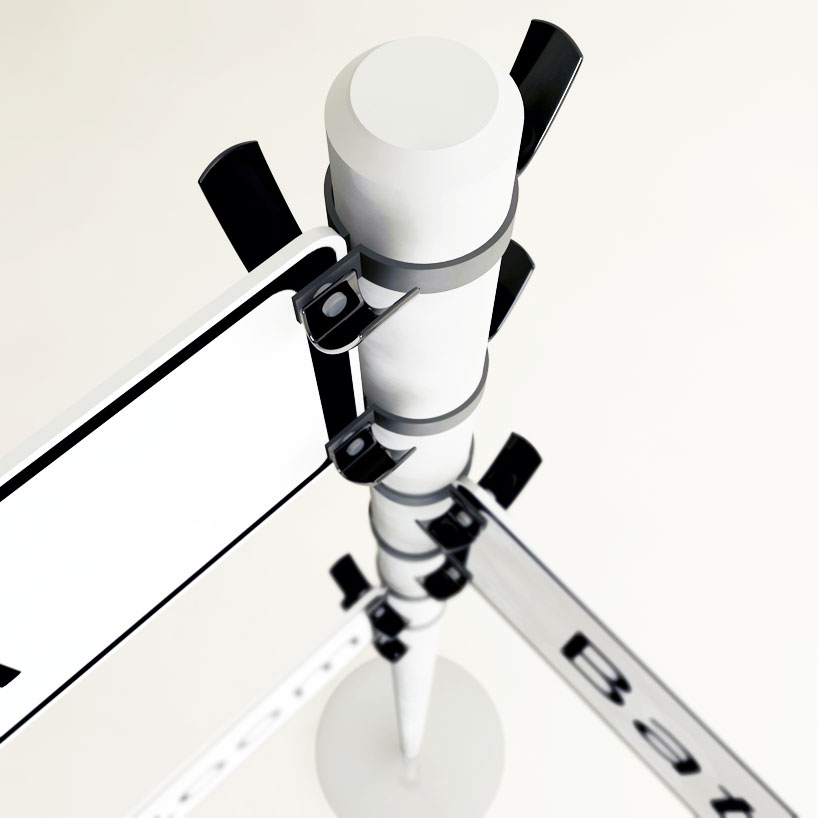
One great man once said that it is the useless things that make life worth living. This inspired design object does not add a lot of functional goodness to the interior, but I want it anyway. Traffic Jam coat hanger, created by serbian designer Vukašin Vukobratović was one of 11 winning projects of the 2011 ‘Young Balkan Designers’ competition. And you can clearly see why. The beauty and humor of this thing are irresistible. To be fair, the signage is interchangeable and can provide an actual direction to human masses in schools, hotels, offices and other public places. And for us, shoebox dwelling creatures, it can become a much needed eye candy.
Source: Designboom